This section of the site is devoted to the profiles of the actors in our play– the Precambrian microfossils. The most common Precambrian microfossils fall into a group known as the acritarchs. This is a broad group of any single-celled, organic-walled (read: no hard parts like shells), vaguely spheroidal (before preservation) microfossil whose biological placement is unknown. The name literally comes from the Greek akritos for confused, or without judge or critic (Evitt, 1963)*.
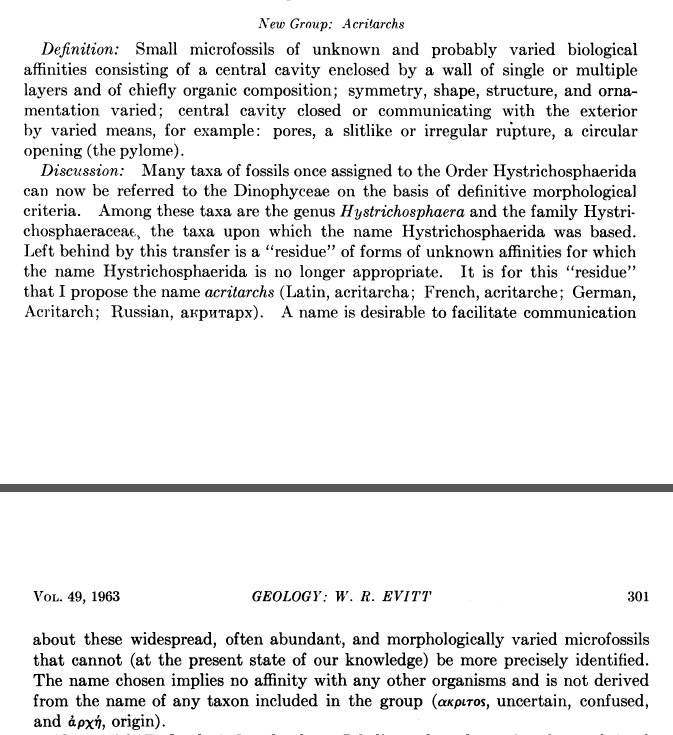
From Evitt, 1963. “A discussion and proposals concerning fossil Dinoflagellates, Hystrichospheres, and acritarchs, II” Proceedings of the National Academy of Sciences, v. 49, p. 298–302.
This group is understood from its inception as what’s known in the parlance as a “trashbag” group- it has no biologically meaning. We know for a fact that very many separate (and not especially closely related clades) are a part of the acritarchs. –But this is only a starting point! As study continues and we learn more about individual acritarch species, we can begin to understand their biological affinities- where they belong. Once that has been determined, it’s no longer considered an acritarch- it has found its forever home.
Here I will post details of these taxa- original and emended descriptions, photos and synonymy lists (that I will continue to update). Much of this will be far too much detail for most readers, but will act as a sort of systematic paleontology section for this site and I hope offer help to other Precambrian paleontologists. **note** I am not making any taxonomic actions in these dossiers of acritarchs and their friends as this website does not conform to the requirements for effective publication outlined by the International Code of Nomenclature for Algae, Fungi and Plants (the code governing acritarchs despite their varied biological affinities).
*I have pdfs of all of the papers I reference here- some of them hard fought! If you are interested in my sending you copies of these, please don’t hesitate to ask!
 Leigh Anne Riedman